
Story and photography by Katie Peterson, originally published in Nashville Catholic
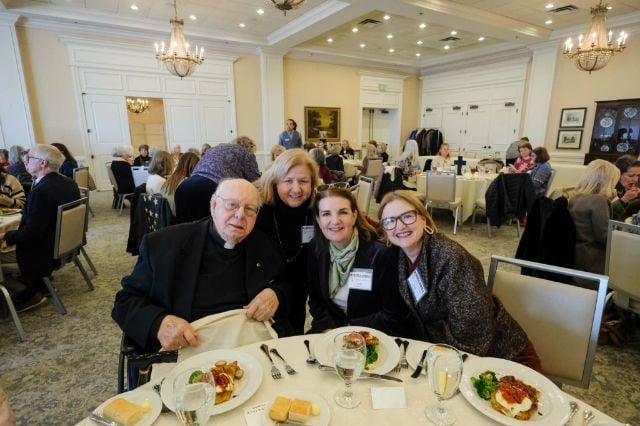
Msgr. Owen F. Campion left the attendees of the Colonna Club with a message during their monthly meeting on Tuesday, Jan. 20, at the Hillwood Country Club: it is the responsibility of Catholics to care for the poor and those in need.
Msgr. Campion’s remarks followed the club’s reading of Father Charles Strobel’s memoir, “The Kingdom of the Poor.” Sally Nance, a member of the club, said there was no one better than Msgr. Campion to lead the discussion.
“They’re both Nashvillians to the core, so when they brought up that they were going to read Father Strobel’s book, I told them I knew who the best person was to lead us,” Nance said. “And I was right.”
During his remarks, Msgr. Campion talked about the history of Catholicism in Nashville, noting several key events that shaped him and Father Strobel, who both graduated from Father Ryan High School in 1958 and 1961, respectively.
“It is very fitting for your meeting today to remember Father Strobel and also his book, ‘The Kingdom of the Poor.’ His ministry to the homeless inspired so many,” Msgr. Campion began, noting the establishment of Strobel House in Nashville, which serves people on the streets, providing shelter, food, and assistance with other needs. “Father Strobel made people of this city think, and Father Strobel’s book makes anyone stop to think. So, let’s think.
“He employs a fascinating technique for an autobiography,” he continued. “In a way, it’s not about him. Instead, he speaks about people who left an impression on him. I intend to expand on the events and the personalities that he mentions that influenced him, about events and personalities that influenced him and me as we were contemporaries and good friends.”
“For Father Strobel and me, our roots lay deeply in Nashville and Catholic Nashville,” Msgr. Campion added. “We came at the tail end of a situation in which Nashville Catholics circled the wagons, and, in that process, we took pride in our Catholic institutions. In this heavily Protestant city, we could say we are not ashamed.”
Some of those institutions included the Little Sisters of the Poor, who sheltered the elderly without charge; the Daughters of Charity, who operated St. Thomas Hospital and cared for prisoners, accepting money but never demanding it; the Sisters of the Blessed Sacrament, who educated African-American youth; St. Mary’s Orphanage, operated by the Dominican Sisters of St. Cecilia; and the Sisters of Mercy, who led many schools. He also recalled pivotal times in history that shaped them, such as the desegregation of schools in Nashville in the late 1950s and the Second Vatican Council in the 1960s.
Msgr. Campion said the message from those institutions and both historical events always remained the same – that all peoples were made in the image and likeness of God and deserved to be treated with dignity.
“At Father Ryan, all of our professors were diocesan priests. They were poised, they were forthright, but they told us firmly that every person is a treasured child of God, entitled to the respect of all,” Msgr. Campion said. “They made their point more than what they said in the classroom.”
He recalled sitting down to lunch in the cafeteria at a spot where he could see everyone in the room. A group of black students came in and sat down at a corner table. When they did, several of the faculty priests, who usually sat together at the center table, got up and joined the black students.
“Under the custom of the time, a white person would never take a bite in the presence of a black person, so that was revolutionary to see these white men go back and sit at the table with the black students,” Msgr. Campion said. “I have never forgotten it.”
Impressions were further made when Msgr. Campion and Father Strobel were in their respective senior years, taking fourth-year religion, which focused on social justice.
“We learned very much,” he said.
Then, when he and Father Strobel were both in seminary, during the Second Vatican Council, he said daily discussions of council proceedings centered around one central theme.
“Always, always, behind every discussion, every day of the council proceedings, somehow, wove in the supreme dignity of each person and of every Catholic’s duty to recognize and enhance that dignity,” Msgr. Campion said. “Pope St. John XXIII convened the councils and, along with other innovations and thinking, he brought to the council a regard for ecumenism, and he encouraged people of different religions and even people of no religion to come together for good purposes.
“That was a big, big thing for the Church and one big aspect of Room In The Inn was Father Strobel’s bringing together various denominations and congregations to assist in that work,” he continued. “That’s a difficult thing to do, but it came naturally to him.”
After reflecting on these key events in the shaping of his own life and that of Father Strobel’s, Msgr. Campion said that Catholics today still have something to be proud of.
“No organization in this country, probably in the world, no institution, no political party, no politician, no social movement, no philosophy, and no person has had as much intimate experience and active involvement with economic ups and downs, with health care, with immigration, with popular conventions and trends, with personal relationships, with education, with international tensions, as had the Catholic Church,” he said.
“I pray that we all think as the Church has thought, as Father Strobel thought. May his loving soul rest in peace.”